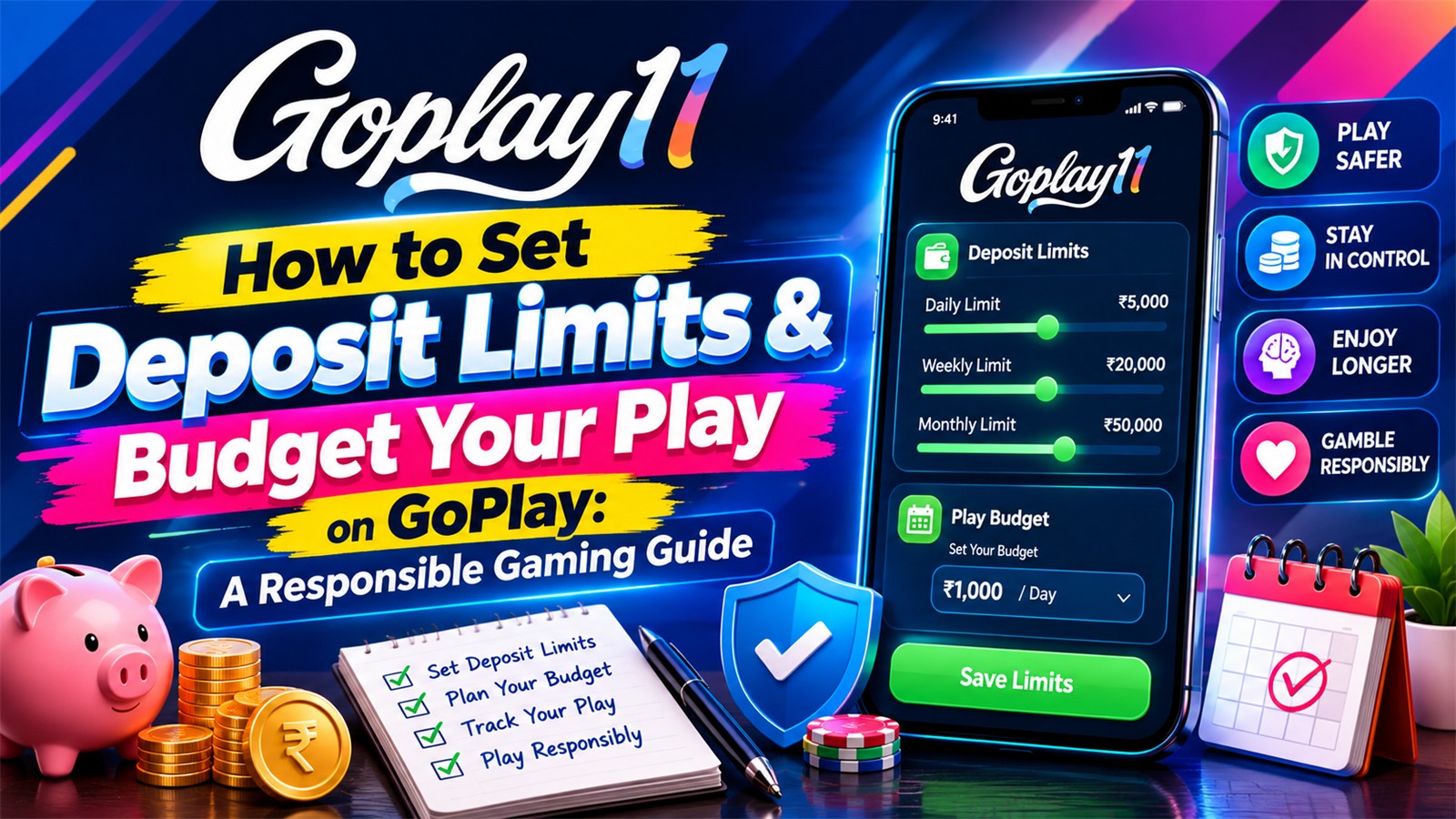
A budget is the only part of real-money gaming that is fully in your hands. You cannot change the house edge, the shuffle or the crash point, but you can decide in advance how much money and how much time an evening of play is allowed to cost. This guide turns that idea into numbers, rules and settings you can put in place today.
Key Takeaways
- Treat gaming as an entertainment cost you could lose in full, never as income, and never with rent, EMI, borrowed or emergency money.
- Build the budget top-down: essentials and savings first, then a small entertainment line, then weekly session budgets split into stake units.
- The real price of play is rounds per hour × stake × house edge. Faster games cost more per hour, even when the RTP looks similar.
- Use every layer: the app's deposit limits, session reminders and cooling-off, plus UPI, bank and phone settings that add friction.
- If you are chasing losses, hiding play or borrowing, stop and talk to someone. Free, confidential help exists in India and is listed below.
Why a Budget Matters More Than Any Strategy
Every game on the app has a built-in house edge, and no betting pattern, prediction or “signal” changes it. A strategy can reduce your mistakes and smooth out swings, but the long-run cost of playing stays where the maths puts it. What you fully control is the amount of money exposed to that edge.
That is why a budget beats a strategy. A strategy might work slightly better or slightly worse, while a ceiling always works: if you have decided that ₹400 is the most you will spend this month, then ₹400 is the most you can lose this month, whatever happens on the screen.
Small, frequent losses are the ones people underestimate. Losing ₹500 in a session feels manageable, yet three such sessions a month adds up to ₹1,500, which is ₹18,000 over a year (₹500 × 3 × 12). A budget makes that number visible before it happens rather than after.
What a budget actually does for you
- It caps the downside. The worst case is known, written down and survivable.
- It separates gaming money from life money. Rent, food and savings are never part of the decision.
- It moves decisions out of the heat of the moment. You choose the limit while calm, so you are not negotiating with yourself after a losing streak.
- It makes the cost visible. You can compare an evening of play with a cinema ticket or a meal out and decide whether it is worth it.
The Mindset: Entertainment Spend, Not Income
The healthiest way to think about real-money gaming is the way you think about a cinema ticket, a concert or a night out. You pay for the time and the excitement, and you accept that the money is spent. If you also win something, that is a pleasant surprise rather than the point.
A simple test helps: if this money disappeared tonight, would anything in my life change? If the honest answer is yes, then it is not gaming money. If the answer is no, and you would simply have a little less to spend on fun this month, then it is a reasonable candidate for an entertainment budget.
Money that must never go into a game
- Rent, EMIs, utility bills, school fees and insurance premiums. These have deadlines and consequences that a game does not care about.
- Borrowed money. That includes loans, credit cards, money from friends, and high-interest instant-loan apps. Borrowing to play turns a loss into a debt.
- Your emergency fund. It exists for medical bills, job loss and family emergencies, and it only works if it is untouched.
- Money that belongs to someone else. Family money, a relative's UPI top-up, business or client funds, and salary you are holding for others.
- Next month's money. Spending future income to fund play today is a warning sign, not a plan.
- Winnings you have not yet decided what to do with. They are real money too, and the stop-win rules later in this guide explain why.
Before anything else: 18+ and where you live
GoPlay Game is for adults aged 18 and over. That is a legal requirement and a safety rule, and the responsible gaming page explains how the site treats it. If anyone under 18 shares your phone, keep the app locked and never save payment details on a shared device.
A Step-by-Step Budget Framework
A good budget works from the top of your income down, so that gaming only ever gets what is left after the things that matter. It takes about twenty minutes to set up. The six steps below use round numbers so you can copy the method with your own figures.
Start from take-home pay
Use the amount that actually reaches your bank account each month, not your CTC or gross salary. If your income varies, use a low, typical month rather than your best one.
Pay essentials and savings first
Rent, EMIs, groceries, transport, bills, family commitments, then a fixed amount for savings and your emergency fund. This part is not negotiable and is never touched by play.
Identify what is genuinely discretionary
What remains is your free money for eating out, shopping, subscriptions, travel and entertainment. Gaming competes with all of those for the same pot.
Set a small gaming line, possibly zero
A commonly quoted rule of thumb, which is a guideline and not a rule, is to keep entertainment gaming spend to a small single-digit percentage of discretionary income. Many people are happiest with a lower figure, and zero is always allowed.
Split the month into weekly session budgets
Divide the monthly line by four to get a weekly amount, then decide how many sessions that covers. Each session gets its own budget that cannot borrow from the next.
Turn each session budget into units
Decide how many rounds you want the money to last and divide. That gives you a stake per round, which is the number that goes into the game.
A worked example (illustrative numbers)
The table below shows two illustrative people using the same method. These are example figures to show the arithmetic, not a recommendation of what you should spend. Player A takes home ₹30,000 a month and Player B takes home ₹60,000.
| Line | Player A (₹30,000) | Player B (₹60,000) | How it is worked out |
|---|---|---|---|
| Essentials (rent, EMIs, food, bills, family) | ₹16,000 | ₹32,000 | About 53% of take-home |
| Savings and emergency fund | ₹6,000 | ₹12,000 | 20% of take-home |
| Discretionary money left | ₹8,000 | ₹16,000 | Take-home minus the two lines above |
| Gaming line (5% of discretionary) | ₹400 | ₹800 | ₹8,000 × 5% and ₹16,000 × 5%; about 1.3% of take-home |
| Weekly gaming budget | ₹100 | ₹200 | Monthly line ÷ 4 |
| Session plan | 1 session of ₹100 | 2 sessions of ₹100 | Your choice; the cap stays the same |
| Units per session | 20 units of ₹5 | 20 units of ₹5 | ₹100 ÷ 20 rounds |
| Worst case over a year | ₹4,800 | ₹9,600 | Monthly line × 12 |
Notice what the framework produces. Even in the worst case, Player A can lose ₹400 in a month without missing a bill or touching savings, and that limit is known before a single round is played. The ₹100 weekly amount also happens to match the ₹100 minimum deposit, so a fresh deposit is exactly one session.
A month is slightly longer than four weeks, so dividing by four leaves a few spare days. Those days do not get a budget of their own. If your discretionary money is small enough that 5% comes to less than one minimum deposit, then the honest answer for that month is to skip play, and that is a perfectly good outcome.
From session budget to stake size
Stake size is where budgets most often break, so it deserves its own rule. The formula is short: stake = session budget ÷ number of rounds you want the session to last. If you want ₹100 to last 20 rounds, the stake is ₹5. If you want ₹500 to last 25 rounds, the stake is ₹20.
For casino-style games where you place a bet at a table, such as Blackjack, Andar Bahar, Dragon vs Tiger and roulette, a common guideline is to risk about 1% to 2% of your session bankroll on each bet. This is a guideline rather than a law, but it stops one unlucky hand from ending the session and forces you to think in units instead of hunches.
| Session bankroll | 1% stake | 2% stake | Bets at 1% | Bets at 2% |
|---|---|---|---|---|
| ₹100 | ₹1 | ₹2 | 100 | 50 |
| ₹500 | ₹5 | ₹10 | 100 | 50 |
| ₹1,000 | ₹10 | ₹20 | 100 | 50 |
| ₹2,000 | ₹20 | ₹40 | 100 | 50 |
You may find that 1% to 2% of a small bankroll is lower than the table's minimum bet. That is useful information: it means that table is too expensive for your budget, so pick a lower-minimum game or a shorter session rather than raising the stake. Check the minimum and maximum bet for each game in the app, since those limits are set by the game and not by this article.
Fast games and slots have bigger swings than a table game, so many players choose a smaller fraction of the bankroll per bet or per spin there. The slots guide explains volatility, and the Aviator guide covers why crash-game stakes deserve extra caution.
The Real Cost of Play: What an Hour Costs on Average
RTP tells you what a game returns over a very long run, and 100% minus RTP is the house edge. Multiply the house edge by everything you stake and you get the expected cost of playing. The formula is: expected hourly cost = rounds per hour × stake × house edge.
This is an average across many rounds, not a prediction for tonight. A real session can finish well ahead or far behind, and the RTP figures are published theoretical values that are not a promise about any one player or evening. What the maths does show is the price of speed.
| Game | Rounds per hour (basis) | House edge (100% − RTP) | ₹20 stake | ₹50 stake | ₹100 stake |
|---|---|---|---|---|---|
| Aviator | ≈300 (about 12 s per round) | 3% (RTP 97%) | ₹180 | ₹450 | ₹900 |
| Andar Bahar | ≈120 (about 30 s per round) | 2.9% (RTP 97.1%) | ₹69.60 | ₹174 | ₹348 |
| Blackjack | ≈100 hands (assumption) | 0.5% (RTP 99.5%) | ₹10 | ₹25 | ₹50 |
| A slot such as Fortune Gems | ≈600 spins (assumption) | 3.3% (RTP 96.7%) | ₹396 | ₹990 | ₹1,980 |
| Rummy (Points) | Several minutes per hand | Skill-based; no fixed edge | Varies with your play, your opponents and any table fee; see the note below | ||
Here is how one row is worked out. Aviator at ₹50 a round with about 300 rounds an hour means ₹15,000 staked (300 × ₹50). Multiply by the 3% house edge and the expected cost is ₹450 an hour (₹15,000 × 0.03). For Andar Bahar at ₹20, 120 rounds an hour is ₹2,400 staked, and 2.9% of that is ₹69.60.
What the table tells you
- Faster games cost more per hour. Aviator's edge (3%) is close to Andar Bahar's (2.9%), yet at the same ₹20 stake Aviator costs about 2.6 times as much per hour (₹180 against ₹69.60) simply because it has 300 rounds an hour instead of 120.
- A low edge only helps if you play the game properly. Blackjack's 0.5% is the lowest on the app, but the published figure assumes correct basic strategy, and doubling or splitting raises the amount staked per hand. Treat the ₹10 as a floor, and read the Blackjack guide before relying on it.
- Stake changes cost in a straight line. Moving from ₹20 to ₹100 multiplies the hourly cost by five in every row.
- Slots are the fastest per hour. At ₹20 a spin, a slot's expected cost (₹396) is about 40 times that of Blackjack at the same stake (₹10).
Turning it into a budget check
Compare the table with the worked example. Player A has a ₹400 monthly line, while an hour of Aviator at ₹50 a round has an expected cost of ₹450, which is more than the whole month. A ₹100 session at a ₹20 stake is just five bets if every one of them loses, which is about a minute of Aviator (5 × 12 seconds) or roughly two and a half minutes of Andar Bahar (5 × 30 seconds).
This is why stake sizing and session length must be set together. A budget that does not consider speed can be gone before you have had a chance to enjoy it. For the mechanics behind each game, see the Andar Bahar and Dragon vs Tiger guide and the games library, which lists every published RTP.
Stop-Loss, Stop-Win and Time Limits: The Walk-Away Rules
A budget tells you how much you may spend. Walk-away rules tell you when a session is over. They are the same idea seen from two sides, and they work best when written down before you open the app.
- Stop-loss: the amount at which the session ends. For most people this is simply the session budget. When it is gone, you stop.
- Stop-win: a target at which you stop even though you are ahead, such as +50% of the session bankroll (an illustrative figure). It does not change the maths, but it protects you from handing everything back in a “just one more” spiral.
- Time limit: a maximum length for the session, because long sessions raise both the amount staked and the chance of mistakes.
Be honest about what these rules do. They do not turn a game in your favour, and a stop-win does not make you a winner. They reduce the chance that one bad or one good run changes your behaviour, and that is worth a great deal.
A rule set you can copy
- Write down the session budget, stop-loss, stop-win and time limit before you deposit.
- Deposit exactly the session budget and nothing more. No top-ups mid-session.
- Set a timer or use the app's session reminder for 30 to 45 minutes and treat it as a hard stop.
- When the stop-loss is hit, close the app. Do not check what would have happened next.
- When the stop-win is hit, stop and withdraw the profit, following the UPI withdrawal guide for KYC and timings.
- Never play when tired, upset, angry or after alcohol.
- Do not change the rules during a session. Change them only afterwards, and only towards tighter.
- Log each session in a note: date, amount in, amount out, minutes played and how you felt.
Set your limits first
Before your next deposit, spend five minutes with the responsible gaming page: the limit tools, the warning signs and the free helplines. 18+, play responsibly.
🛡 Open the Responsible Gaming PageLimit Tools: In the App and Beyond It
Rules on paper are good, and rules the software enforces are better. The GoPlay responsible gaming page describes several controls, and your phone and bank add more. The strongest setup uses both, because each catches what the other misses.
GoPlay's built-in tools
The responsible gaming page lists these controls. Some are set in the app's settings, and others (cooling-off and self-exclusion) are arranged through support.
| Tool | What it does | Good for |
|---|---|---|
| Daily deposit limit | Caps what you can deposit in 24 hours | Stopping a same-day chase |
| Weekly / monthly limit | Caps deposits over a rolling 7 or 30 days | Enforcing your monthly gaming line |
| Session-time reminder | Notifies you after a set session length | Losing track of time |
| Reality check | Pop-ups showing how long you have played | Snapping out of autopilot |
| Cooling-off (24 hours, 7 days, 30 days) | Temporarily blocks your account, arranged via support | Taking a break after breaking your own rules |
| Self-exclusion | Closes your account for an extended term, arranged via support | When play is causing harm |
How to set them
Set the limits before your first deposit
If you have not installed the app yet, the download page covers the install steps. Then open the app's settings and look for the responsible gaming or deposit limit section.
Set a daily limit equal to one session
In the worked example, Player A would set ₹100 and Player B ₹200. The daily limit should never be higher than the session budget you wrote down.
Add weekly and monthly limits
Match your framework: ₹100 weekly and ₹400 monthly for Player A, ₹200 and ₹800 for Player B. These are the ceilings that cap a bad week.
Turn on the session reminder and reality check
Choose a reminder interval at or below your time limit, for example 30 minutes. Do not dismiss the pop-ups without reading them.
Understand which way the delay works
Lowering a limit takes effect immediately. Raising one requires a 48-hour cooling-off, so an impulsive top-up cannot undo a sensible limit in the middle of a bad session.
Ask support for cooling-off or self-exclusion when needed
These are arranged through GoPlay Game support rather than a toggle. Ask for the 24-hour, 7-day or 30-day option, or for self-exclusion, and keep the confirmation message.
Cooling-off or self-exclusion: which one?
Cooling-off is a pause. Use it if you have broken your own rules twice in a week, if a bad session is on your mind, or if you simply want a reset. A 24-hour block is enough for many people, and 7 or 30 days suits a longer reset.
Self-exclusion is a step back. Use it if play is harming your finances, relationships or mood, or if cooling-off periods keep ending with you returning to the same pattern. The responsible gaming page describes it as not reversible during the chosen term, which is the point, so choose it deliberately.
Limits outside the app
An app's own limits only cover that app. A few settings elsewhere add friction, and friction is what turns an impulse into a pause.
- A separate account or UPI ID for gaming money. Move the monthly gaming line into it at the start of the month and use only that for deposits. When it is empty, you are done until next month.
- UPI and bank limits. Many UPI apps and banks let you lower your per-transaction or daily transfer limit or add extra confirmation. Check what your bank and UPI app offer, since these vary.
- SMS and app alerts on every debit. Seeing each payment as it happens makes small top-ups feel real, and it makes a pattern hard to hide from yourself.
- No saved cards or stored payment details. Typing in details each time is a helpful pause. The site's responsible gaming page also advises against saving payment details on shared devices.
- No credit-based funding. Do not fund play from a credit card, an overdraft or a credit line linked to UPI, because that is borrowed money by another name.
- Phone timers. On Android, Digital Wellbeing app timers can lock an app for the rest of the day once you reach your time limit. Other phones have similar screen-time features.
- Log out after each session. Having to sign in again adds one more moment to think.
How Bonuses and Cashback Can Undermine a Budget
The welcome bonus is bonus credit with wagering requirements, not cash, and there is also a standing 15% cashback on deposits. Both can be worth having in the right circumstances, but both can also quietly change how much you play. The welcome bonus guide explains the maths in full.
The risk is behavioural. A wagering requirement asks you to stake a multiple of the bonus before it can be withdrawn, which means longer sessions and more rounds than you had planned. Because the total amount staked is what the house edge acts on, more wagering means a higher expected cost, even while the bonus balance looks like free money.
An illustrative example
Suppose a ₹500 bonus came with a 20× wagering requirement. This is an example number only, so check the real multiplier in the app's Promotions section. That would mean ₹10,000 of bets (₹500 × 20).
At ₹20 a round on Aviator, that is 500 rounds (₹10,000 ÷ ₹20), or about 100 minutes at 12 seconds a round (500 × 12 seconds = 6,000 seconds). The expected cost of that wagering at a 3% house edge is ₹300 (₹10,000 × 0.03). If a game counted at only 10% towards wagering, which is also illustrative, the same requirement would need ₹1,00,000 of bets. The point is not the exact figures but the pressure to keep playing well beyond a session limit.
Rules for bonuses and cashback
- Decide the deposit first. Choose your session budget, then see whether a bonus fits. Never raise a deposit to “qualify”.
- You can decline the bonus. Playing with cash only keeps the game simple and the session under your control.
- Read the terms in the app. Check the wagering multiplier, game weighting, maximum bet while a bonus is active, expiry window and maximum cash-out before you accept.
- Treat cashback as a small rebate, not a safety net. Check the Promotions screen for how it is calculated and paid. Even in the best case it returns a fraction of what you spent and should never justify a bigger deposit.
- Do not let an expiry date set your schedule. A ticking bonus clock is a pressure tactic on your time, so let the bonus lapse if it does not fit your plan.
The Psychology of Overspending
Overspending is rarely a maths problem. It usually comes from a handful of predictable thoughts that feel reasonable at the time. Recognising the thought is the first step to not acting on it.
| The thought | What is actually going on | What to do instead |
|---|---|---|
| “I will just win it back.” | Loss chasing. Each round is independent, and new money only adds new risk. Also, a fall from ₹1,000 to ₹500 needs a 100% gain to recover, not 50%. | Stop. Apply the 24-hour rule. Treat the loss as the price of the evening. |
| “I have already put ₹500 in; I cannot stop now.” | Sunk cost. The ₹500 is gone whether you continue or not. | Ask: would I deposit the next ₹100 fresh, right now? If not, stop. |
| “That was so close; I am nearly there.” | Near-miss effect. A near-miss is still a loss, but it feels like progress and pulls you to play again. | Count it as a loss. Take a short walk before you decide anything. |
| “I am due a win.” | Gambler's fallacy. In RNG games a run of losses does not make the next round more likely to win. | Stay with your session budget and stop-loss rather than a feeling. |
| “I am up, so this is house money.” | Mental accounting. Winnings are your money, and treating them as free encourages bigger stakes. | Use a stop-win and withdraw. Never raise stakes because you are ahead. |
| “Just one more round.” | A rule quietly being renegotiated in the moment, usually near the time or loss limit. | Let the timer decide. Close the app when it rings. |
| “I have spotted a pattern.” | Illusion of control. Predictor apps and pattern groups sell certainty that the maths does not contain. | Read the strategy guides for what a pattern can and cannot do. Keep stakes at your unit. |
| “I need a distraction from today.” | Playing to cope. Gaming can make stress worse and it does not fix it. | Do something else first: a walk, a call, a meal. If it is regular, speak to someone. |
When not to play at all
Decisions get worse in predictable conditions. Do not play when you are tired, angry, upset or lonely, after an argument, after a bad day at work, or after alcohol, which lowers your inhibitions and blurs your sense of how much you have spent. If you notice you are playing to change how you feel, put a pause between the feeling and the app.
Warning Signs and a Quick Self-Check
Problem gambling can affect anyone, and it tends to build slowly. The responsible gaming page lists six warning signs, and it is worth reading them slowly and honestly.
- Chasing losses. Continuing to play to win back money you have already lost.
- Hiding your play. Lying to family or friends about how much time or money you spend.
- Losing track of time. Playing far longer than intended and neglecting work, studies or relationships.
- Playing to cope. Using gaming to escape stress, anxiety, low mood or difficult situations.
- Financial stress. Borrowing, selling belongings or missing bills to fund gaming.
- Irritability when stopping. Feeling restless or anxious when you try to cut down.
A short self-check
Answer these privately, and be kind to yourself while you do. In the last three months, have you:
- Spent more than the amount you set before starting?
- Deposited again in the same session after your budget ran out?
- Played a longer session than you meant to, more than once?
- Felt anxious, guilty or low after playing?
- Thought about play while at work, at family events or when trying to sleep?
- Used money meant for bills, savings or someone else?
- Told someone a smaller number than the real one?
- Tried to cut back and found it harder than you expected?
None of these makes you a bad person, and one “yes” is a reason to tighten your limits. Two or more is a reason to talk to someone you trust. The self-assessment quiz on the responsible gaming page is a quick, private check, and its results are not stored or shared. It is a prompt to think, and it is not a diagnosis.
After a Bad Session: The 24-Hour Rule
Everyone has a session that goes badly, and what you do in the next few hours matters more than the loss itself. The single most protective habit is the 24-hour rule: after a session that has hurt, do not deposit or play again for at least 24 hours.
- Stop and close the app. Do not check the next round or replay the last hand in your head.
- Do not top up. A second deposit tonight is almost always chasing.
- Write down what happened. Note the amount, the time, what you were feeling and which rule you broke, if any.
- Sleep on it. Decisions about money are better made after rest and a meal.
- Talk to someone. You can say: “I spent more on gaming than I planned and I would like to tell someone.” Saying it out loud takes away much of the shame.
- Tighten one limit. Lowering a limit takes effect immediately, so use it. Consider a 24-hour or 7-day cooling-off via support if you feel pulled to play.
If the money was meant for something else
If you have lost money that was set aside for a bill, an EMI or rent, deal with that bill first. Tell the lender, landlord or school early, because most will work with someone who speaks up sooner rather than later. Do not take a high-interest instant loan or borrow from a friend to cover the gap, and do not try to win it back. A free counsellor from the helplines below can help you plan the next steps.
Helping Someone Else, and Where to Get Free Help
If someone close to you seems to be struggling, you may be the first person to notice. It is a delicate conversation, and a calm, private and non-judgmental approach gives the best chance of it going well.
Do
- Choose a private, calm moment, not straight after a loss or an argument
- Start with concern: “I have noticed you seem stressed, and I am worried about you”
- Listen more than you talk, and stay curious rather than accusing
- Suggest practical steps together: limits, a cooling-off, a helpline call
- Offer to sit with them while they call or set the limits
- Look after your own wellbeing, and seek support for yourself too
Don't
- Shame, lecture or threaten. That usually pushes people to hide more
- Give them money to “fix” it, or pay off debts without a plan
- Take over their accounts or devices without their agreement
- Expect a single conversation to solve it
- Ignore your own limits or finances while trying to help
- Wait for a crisis before you raise it
Free helplines in India
These are the services listed on our responsible gaming page. They are counselling and mental-health services, so they are places to talk, not places to recover money. Contact details can change, so confirm them on the responsible gaming page if a call does not connect.
| Service | Contact | Hours and notes |
|---|---|---|
| iCall (TISS) | 9152987821 | Mon–Sat, 8am–10pm; free psychological counselling |
| Vandrevala Foundation | 1860-2662-345 | 24/7; free, confidential mental-health support |
| NIMHANS | 080-46110007 | National Institute of Mental Health; addiction counselling |
| iCall chat | icallhelpline.org | Chat-based counselling if you prefer not to call |
Your One-Page “My Limits” Checklist
Copy this into your phone's notes and fill in each line in your own numbers. It takes five minutes, and it is the piece of this guide most worth doing today.
| Done | My rule | My number or setting |
|---|---|---|
| ☐ | Monthly take-home | ₹ ______ |
| ☐ | Essentials and savings paid first | ₹ ______ |
| ☐ | Discretionary money left | ₹ ______ |
| ☐ | Gaming line for the month (possibly zero) | ₹ ______ |
| ☐ | Weekly budget and number of sessions | ₹ ______ × ____ sessions |
| ☐ | Stake per round (session budget ÷ rounds) | ₹ ______ |
| ☐ | Stop-loss and stop-win for a session | ₹ ______ / ₹ ______ |
| ☐ | Time limit and days off each week | ____ min / ____ days |
| ☐ | Daily, weekly and monthly deposit limits set in the app | ₹ ____ / ₹ ____ / ₹ ____ |
| ☐ | Session reminder and reality check switched on | Every ____ min |
| ☐ | Separate gaming UPI ID or account, alerts on, no saved cards | Yes / No |
| ☐ | One person I will tell if I break a rule | Name: ________ |
What good limits look like, and what fake limits look like
A limit only protects you if it can actually stop you. Many people set numbers that look responsible and are quietly built to be overridden, so it is worth checking yours against both columns.
Good limits
- Set in advance, in writing, in your own numbers
- Enforced by something outside your willpower: an app limit, a separate account or a bank setting
- Smaller than the money you could comfortably lose
- Only ever tightened after a bad session, never loosened in the heat of it
- Known to at least one other person
Fake limits
- “I will just be careful” with no number attached
- A limit set so high it can never be reached
- A budget you can top up from a credit card, a loan or savings
- A stop-loss you renegotiate after the third loss
- A limit you raise the same evening you hit it
If you are not sure which column describes you, that is worth exploring, and there is no shame in it. The responsible gaming page has the tools and helplines, and the contact page is there if a step in this guide does not match what you see in the app.