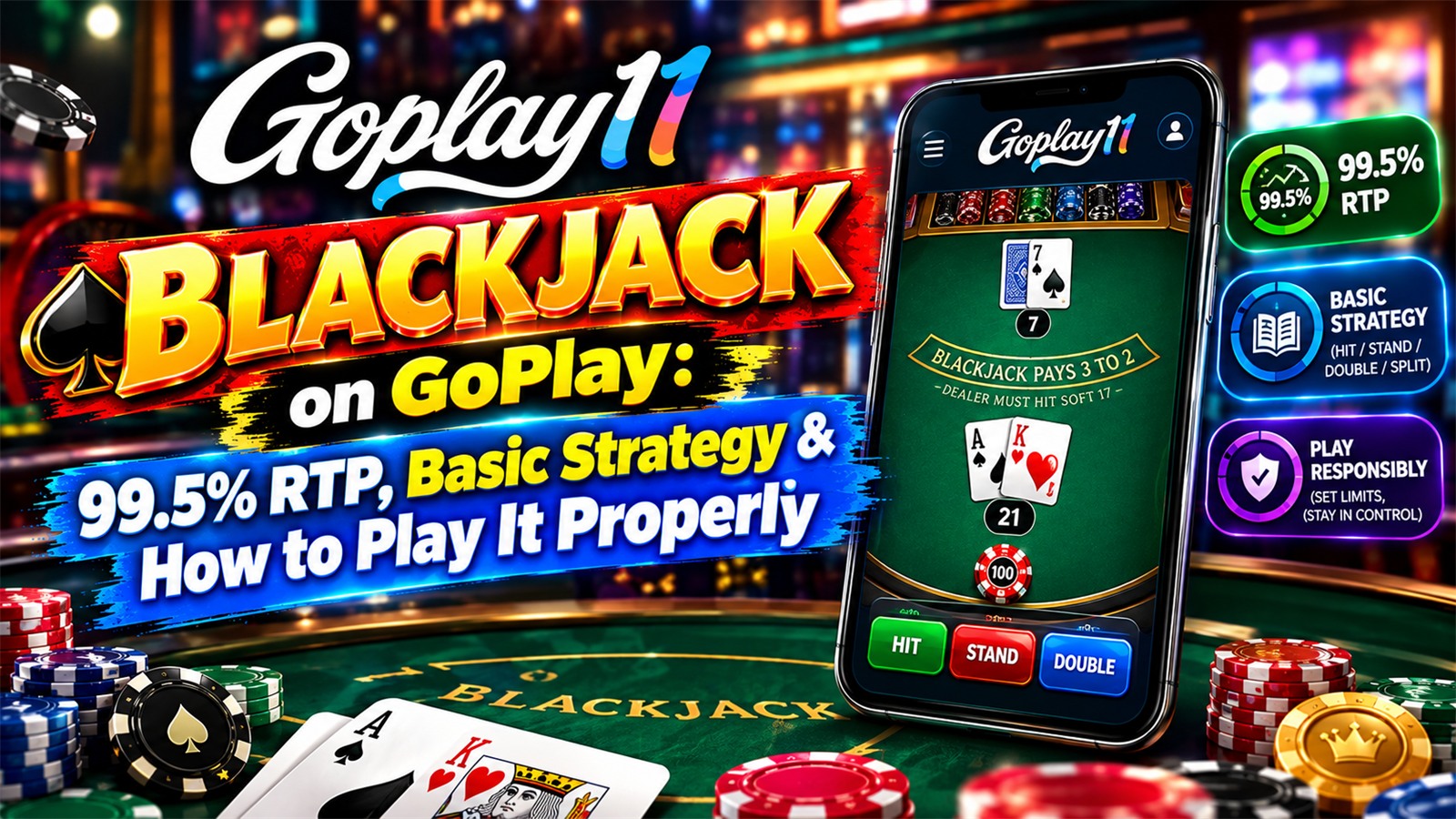
Blackjack is the game on GoPlay where the arithmetic is closest to your side: a published RTP of 99.5%, which implies a house edge of about 0.5%. But that number is a theoretical ceiling that assumes every hand is played by the book, and how you actually play decides how much of it you keep. This guide covers what the figure means, the exact charts, the rules and habits that quietly cost money, and the systems that do nothing at all.
Key Takeaways
- GoPlay lists Blackjack at a 99.5% RTP, a house edge of about 0.5% and the best figure in its library. It assumes near-perfect basic strategy and is a long-run average, not a session promise.
- Basic strategy is a fixed chart of hit, stand, double and split decisions. Following it is worth several percentage points compared with playing by feel, but it still cannot make the edge negative.
- Table rules matter. A 6:5 payout for a natural instead of 3:2 adds roughly 1.4 percentage points to the house edge, close to three times the whole edge of a good table.
- Never take insurance. Its expected return is about -7.7% of the stake, because roughly 30.8% of cards are ten-values while you would need 33.3% to break even.
- No betting system changes the maths. Martingale, Paroli and streak-spotting only reshape variance; card counting and predictor apps do not apply to an online table.
Why Blackjack Has the Highest RTP on GoPlay (and What 99.5% Assumes)
Blackjack's 99.5% is the highest published RTP among the 14 games in GoPlay's library, ahead of Auto Roulette at 97.3%, Limbo at 97.2% and Andar Bahar at 97.1%. House edge is simply 100% minus RTP, so here it is 0.5%: on average the game keeps ₹0.50 of every ₹100 wagered, against ₹3.20 for Teen Patti (96.8%) and ₹3 for Aviator (97%).
The reason is structural. In most games the edge comes from a payout table set slightly below the true odds. In Blackjack the payouts are simple (even money, with a bonus for a natural), and the edge exists mainly because you act before the dealer: if you bust, you lose immediately, even though the dealer might have busted too. Every decision you make changes how much of that structural edge you keep, which is why Blackjack is one of the few games where your choices move the number so much.
What the 99.5% assumes
A published RTP is a theoretical figure calculated for a specific rule set and a specific style of play. For Blackjack, the standard calculation assumes you make the mathematically best decision on every hand, which is what basic strategy encodes, and that the table rules are the ones the game describes. It is the game's published theoretical number, and the rules screen inside the app is where you check which rules sit behind it.
- It assumes near-perfect play. The figure is an upper bound on what a player can return. A player who guesses, hunches or copies the dealer returns less, sometimes far less (a later section quantifies this).
- It is a long-run average. Over tens of thousands of hands the result converges toward the theoretical number. Over one evening it does not, and the swings are much larger than the 0.5% (see the variance section).
- It belongs to a rule set. Change the natural payout, the deck count or the dealer's soft-17 rule and the same charts produce a different edge.
- It is about money wagered, not money deposited. Winnings get re-bet, so a ₹1,000 deposit can generate ₹15,000 of wagering in a single hour.
How a Round of Blackjack Works
The goal is to finish with a total closer to 21 than the dealer's without going over. You are not playing against other players, only against the dealer's hand, and the dealer has no decisions to make: the rules dictate every action.
| Card | Value | Notes |
|---|---|---|
| 2 to 10 | Face value | A 7 is worth 7, a 10 is worth 10 |
| Jack, Queen, King | 10 | Together with the 10s these are the "ten-values": 16 of the 52 cards in a deck |
| Ace | 1 or 11 | Counts as 11 unless that would bust the hand, then as 1 |
A soft hand contains an Ace counted as 11 (an Ace and a 6 is "soft 17"), so one more card can never bust it. A hard hand has no Ace, or has an Ace forced to count as 1, and any card that takes it over 21 busts it. A natural (blackjack) is an Ace plus a ten-value as your first two cards; 21 made with three or more cards is not a natural.
Naturals are rarer than they feel. The chance your first two cards are an Ace and a ten-value is 2 × (4/13 × 1/13) = 8/169, about 4.7% of hands, or roughly once in every 21 hands (with many decks, the figure is very slightly lower).
Place your bet
You stake your chosen amount before any card is dealt. Doubles and splits later add to the amount at risk in that round.
Two cards each, one dealer card face up
You see both of your cards and the dealer's upcard. The dealer's second card (the hole card) stays hidden.
Naturals and insurance
If the dealer's upcard is an Ace, insurance is offered. Many tables also have the dealer check for a natural at this point; if the dealer has one, the round ends before you act.
Your decisions
You choose hit, stand, double down or split, as the hand allows, until you stand, double or bust. A bust loses immediately, before the dealer plays.
The dealer plays by fixed rules
The dealer must hit on 16 or less and stand on 17 or more. Whether the dealer hits or stands on soft 17 is a table rule that changes the edge, so check it.
Settlement
A win pays 1:1, a natural pays 3:2 at a good table (6:5 at a poor one), a tie is a push and returns your stake, and a loss forfeits it.
The buttons, and what each really does
| Action | What it does | Watch for |
|---|---|---|
| Hit | Take one more card | Can be repeated until you stand or bust |
| Stand | Keep your total and end your turn | The dealer then plays out the hand |
| Double down | Double your stake, take exactly one more card, then stand | Usually allowed on your first two cards; the rules screen shows which totals qualify |
| Split | Turn a pair into two hands, each with its own equal stake | Split aces often receive only one card each; a split ten-plus-Ace is not a natural |
| Insurance | A separate side bet, up to half your stake, when the dealer shows an Ace | Pays 2:1 if the dealer has a natural; the maths is poor (see below) |
| Surrender | Give up half your stake and end the hand | Only if the rules screen lists it; GoPlay's game description mentions double down, splits and insurance |
Table Rules That Change the House Edge
The 99.5% figure ties to one particular rule set, and the same game can carry a very different edge if the rules move. The table below shows the approximate effect of the most common differences on a game that otherwise follows the baseline (many decks, dealer stands on soft 17, double after split allowed, 3:2 natural), played with perfect basic strategy. Figures are approximate and shown in percentage points of the amount wagered.
| Rule difference | Approximate change in house edge | Why |
|---|---|---|
| Baseline: 4–8 decks, dealer stands on soft 17, double after split, 3:2 natural | About 0.4% to 0.5% | Consistent with a 99.5% RTP |
| Natural pays 6:5 instead of 3:2 | +1.4 points | A natural comes about 4.7% of hands and each is short by 0.3 of a bet |
| Natural pays even money (1:1) | +2.4 points | 4.7% × 0.5 of a bet lost on each natural |
| Dealer hits soft 17 | +0.2 points | The dealer improves more often from soft 17 |
| No doubling after a split | +0.1 points | Removes a profitable follow-up play |
| Doubling limited to certain totals | A fraction of a point | Removes some profitable doubles |
| Dealer takes no hole card until you finish | About +0.1 points | Doubles and splits can lose extra to a late dealer natural |
| One deck instead of eight | About −0.5 points | Fewer decks favour the player, but single-deck tables often pay 6:5 to cancel it |
| Late surrender allowed | About −0.07 points | Lets you lose half instead of most of a bad hand |
| RNG versus live shoe | No direct change | Affects card counting and pace, not the rule maths |
The 6:5 line deserves the most attention because it is the one players fail to notice. On a ₹100 bet, a natural pays ₹150 at 3:2 but only ₹120 at 6:5, a difference of ₹30. Multiply by the 4.7% frequency of naturals and it costs about ₹1.42 per ₹100 wagered, which is nearly three times the entire 0.5% edge of the good version of the game.
What to check on the rules screen before your first hand
Find the natural payout
3:2 (sometimes shown as "pays 1.5") is the standard. 6:5 (or "pays 1.2") is a red flag. If the screen does not say, ask support before playing large stakes.
Check the dealer's soft 17 rule
"Dealer stands on all 17s" is the player-friendly version. "Dealer hits soft 17" adds roughly 0.2 points and shifts a few cells of the strategy chart.
Note the doubling and splitting rules
Look for double on any two cards, double after split, how many times you can re-split, and whether split aces get one card only. Each restriction is a small extra cost.
See whether surrender or a hole-card check exists
Surrender lowers the edge slightly. Whether the dealer checks for a natural before you act determines how risky it is to double or split against a ten or an Ace.
Look at decks, shuffling and table limits
Deck count changes the edge a little, and the minimum and maximum bet decide how much room you have for your bankroll plan. Illustrative limits appear later; the real ones are in the app.
Identify any side bets and switch them off
If the table offers optional side bets, read their paytables but leave them unplayed unless you are deliberately paying for entertainment (see the insurance and side-bet section).
If any of this is unclear in the app, the support address listed in the site footer is hello@apkgoplay.com (Mon–Sun, 10am–8pm IST).
The Dealer's Upcard Drives Every Decision
Because the dealer must keep drawing until reaching 17, the single most useful piece of information on the table is the dealer's upcard. A dealer showing a 5 or a 6 is in the weakest position in the game and busts around 42% of the time; a dealer showing a 10 busts only about one time in five.
| Dealer upcard | Dealer busts (approx.) | How to think about it |
|---|---|---|
| 2 | 35% | Weak; the dealer still makes a hand about two times in three |
| 3 | 37% | Weak |
| 4 | About 40% | Weak; your best chances to double and split |
| 5 | 42% | The dealer's worst card |
| 6 | 42% | The dealer's worst card |
| 7 | 26% | Strong: dealer ends on 17 more often than any other total |
| 8 | 24% | Strong |
| 9 | 23% | Strong |
| 10 | 21% | Strong; a natural is possible |
| Ace | About 12% | The dealer's best card; a natural is possible |
These are approximate figures for a many-deck game where the dealer stands on all 17s. They are averaged over every possible hole card, including a natural. For a 10 or an Ace showing, once the dealer has checked and confirmed there is no natural, the bust rates for the hands still in play rise to roughly 23% and 17%. The natural chance is 1/13 (7.7%) for a ten showing and 4/13 (30.8%) for an Ace.
The logic this creates
- Against a 2 to 6, let the dealer bust. Stand on hard 12 to 16 (with small exceptions at 12 against a 2 or 3), and take your extra risks (doubles and splits) where the dealer is most likely to fail.
- Against a 7 to Ace, assume the dealer has 17 or more. Standing on 12 to 16 wins only when the dealer busts, which happens too rarely, so you hit and accept the risk of busting yourself.
- The dealer's bust rate is your break-even. When you stand on a total that loses to every finished dealer hand of 17 or more, your win probability is simply the chance the dealer busts.
Take the classic uncomfortable hand: 16 against a dealer 10. Standing wins only if the dealer busts, about 23% of the time once a natural is ruled out, and loses the other 77%, for an expected result of 0.23 − 0.77 = −0.54 of your bet. Hitting busts immediately about 62% of the time (any 6, 7, 8, 9 or ten-value takes 16 over 21: 8 of 13 card values) but leaves you competitive the rest of the time, and its expected result is also about −0.54, a shade smaller. Both are bad; the chart picks the marginally smaller loss.
Basic Strategy: The Three Charts
Basic strategy is the set of plays that minimise the house edge when you only know your own cards and the dealer's upcard. It was derived by computing the expected result of each option for every combination of hand and upcard and choosing the best one. Use the three charts below, in order: pairs first (if you hold one), then soft hands (if you hold an Ace counted as 11), then hard totals.
Key: H = hit, S = stand, D = double (hit if doubling is not allowed), Ds = double (stand if doubling is not allowed), P = split. Columns show the dealer's upcard.
Chart 1: Hard totals (no pair, no Ace counted as 11)
| Your hand | 2 | 3 | 4 | 5 | 6 | 7 | 8 | 9 | 10 | A |
|---|---|---|---|---|---|---|---|---|---|---|
| 8 or less | H | H | H | H | H | H | H | H | H | H |
| 9 | H | D | D | D | D | H | H | H | H | H |
| 10 | D | D | D | D | D | D | D | D | H | H |
| 11 | D | D | D | D | D | D | D | D | D | H |
| 12 | H | H | S | S | S | H | H | H | H | H |
| 13 to 16 | S | S | S | S | S | H | H | H | H | H |
| 17 or more | S | S | S | S | S | S | S | S | S | S |
Chart 2: Soft totals (an Ace counted as 11)
| Your hand | 2 | 3 | 4 | 5 | 6 | 7 | 8 | 9 | 10 | A |
|---|---|---|---|---|---|---|---|---|---|---|
| A,2 (soft 13) | H | H | H | D | D | H | H | H | H | H |
| A,3 (soft 14) | H | H | H | D | D | H | H | H | H | H |
| A,4 (soft 15) | H | H | D | D | D | H | H | H | H | H |
| A,5 (soft 16) | H | H | D | D | D | H | H | H | H | H |
| A,6 (soft 17) | H | D | D | D | D | H | H | H | H | H |
| A,7 (soft 18) | S | Ds | Ds | Ds | Ds | S | S | H | H | H |
| A,8 (soft 19) | S | S | S | S | S | S | S | S | S | S |
| A,9 (soft 20) or A,10 | S | S | S | S | S | S | S | S | S | S |
Chart 3: Pairs
| Your pair | 2 | 3 | 4 | 5 | 6 | 7 | 8 | 9 | 10 | A |
|---|---|---|---|---|---|---|---|---|---|---|
| A,A | P | P | P | P | P | P | P | P | P | P |
| 10,10 | S | S | S | S | S | S | S | S | S | S |
| 9,9 | P | P | P | P | P | S | P | P | S | S |
| 8,8 | P | P | P | P | P | P | P | P | P | P |
| 7,7 | P | P | P | P | P | P | H | H | H | H |
| 6,6 | P | P | P | P | P | H | H | H | H | H |
| 5,5 (play as hard 10) | D | D | D | D | D | D | D | D | H | H |
| 4,4 | H | H | H | P | P | H | H | H | H | H |
| 3,3 | P | P | P | P | P | P | H | H | H | H |
| 2,2 | P | P | P | P | P | P | H | H | H | H |
These splits assume doubling after a split is allowed. If it is not, pairs of 2s and 3s split only against a 4 to 7, 6s only against a 3 to 6, and 4s are never split. A handful of cells are genuinely close calls: 12 against a 4, 16 against a 10 and A,2 against a 5 each differ from the alternative by less than 0.01 of a bet, so following a slightly different published chart there costs almost nothing. What matters is choosing one chart and applying it every time.
The chart in six sentences
- Against a dealer 7 to Ace, keep hitting hard totals until you reach 17.
- Against a dealer 2 to 6, stand on hard 13 to 16 (and on 12 against a 4, 5 or 6).
- Double hard 11 against anything except an Ace, hard 10 against anything below a 10, and hard 9 against a 3 to 6.
- Double soft hands only when the dealer is weak (mostly a 4 to 6), and never stand on soft 17 or worse.
- Always split Aces and 8s; never split 10s, 5s or 4s (except 4s against a 5 or 6 when doubling after a split is allowed).
- Never take insurance or even money.
Why the Chart Says What It Says
Memorising cells works for a while, but understanding the reasons makes the chart hard to forget and easier to adapt when the rules change. Each of the big plays follows from the same arithmetic you have already seen: the dealer's bust rate and the frequency of ten-values, which make up 4/13, or about 30.8%, of the cards.
Why you double 11 (and 10, and sometimes 9)
With 11, any ten-value (30.8% of cards) makes 21, and every card from 2 to 9 gives you a total between 13 and 20 with no risk of busting on that draw. Doubling puts twice as much money on a hand that is a big favourite. Against a dealer 6, doubling 11 is worth about +0.67 of your original bet on average, against about +0.33 for simply hitting, so the double is roughly twice as profitable.
It changes against an Ace because the dealer's best card cuts your edge: hitting 11 against an Ace is worth about +0.14 per bet while doubling is about +0.12, so you would be committing double the money to a spot that pays slightly less. Against a 10, doubling 11 is still ahead (about +0.18 against about +0.12 for hitting), though far less dramatically than against a 6.
Why 16 against a 10 is a judgement call
You have already seen the arithmetic: both options lose about 54% of a bet on average. Standing loses to any dealer 17 to 21, and hitting busts you more often than not. The chart says hit because the expected loss is a shade smaller (a difference of about 0.005 of a bet), and because hitting rescues the hands where you draw an Ace, 2, 3, 4 or 5 and land on 17 to 21. If your table offers surrender, giving up half (an expected result of −0.50) beats both.
Why you always split 8s and Aces, and never 10s or 5s
- 8,8. Sixteen is the worst starting total. Two hands starting on 8 are much better than one hand on 16: against a dealer 6, splitting is worth about +0.33 per bet, while standing on 16 loses about 0.15. Against a dealer 10 the split still loses (about −0.49) but less than standing or hitting 16 (about −0.54).
- A,A. A pair of Aces is 2 or 12, a poor total, but each Ace is the best starting card for a new hand. Each split hand becomes 21 about 30.8% of the time (though split naturals pay only 1:1), and splitting turns a weak total into two strong starts.
- 10,10. Twenty already wins most hands. Against a dealer 6 it is worth roughly +0.70 per bet, and against a 10 about +0.55, whereas splitting into two new hands starting on 10 gives up most of that certainty.
- 5,5. Two 5s are a hard 10, one of the best doubling hands. Splitting two 5s would replace that with two weak starting hands.
Why soft hands behave differently
A soft hand cannot bust on the next card, so hitting or doubling it is a free look: the worst case is a lower hard total, not an immediate loss. That is why the chart doubles soft hands against a dealer 4 to 6 (where you profit most from the extra stake) and hits soft 13 to 17 elsewhere. Soft 18 is the awkward one: it beats a dealer 17 but loses to 19 and better, and against a 9, 10 or Ace the dealer reaches 19 or better often enough that hitting is a slightly better gamble than standing.
Try Blackjack on the GoPlay11 app
Double down, split and insurance are all available, with a published 99.5% RTP. Check the rules screen first, set a budget in advance, and play within it. 18+ only, play responsibly.
▼ Download GoPlay11 APKInsurance and Side Bets: The Expensive Extras
Insurance is offered when the dealer's upcard is an Ace. You may place up to half your stake as a separate bet that pays 2:1 if the dealer has a natural. It feels sensible, like protection for your hand, but it is a bet on the dealer's hidden card and has nothing to do with the strength of your own.
Here is the arithmetic. A ten-value hole card completes a natural, and ten-values make up 4/13 of the cards, about 30.8%. Insurance pays 2:1, so you need the natural to appear one time in three (33.3%) just to break even. Per ₹1 insured, the expected result is 2 × (4/13) − 1 × (9/13) = −1/13 = −0.077, which is −7.7%. On a ₹100 hand with ₹50 of insurance, you expect to lose about ₹3.85 every time you take it.
Even money is insurance in disguise
If you hold a natural and the dealer shows an Ace, some tables offer "even money", a guaranteed 1:1 payout. Take it and you always receive ₹100 on a ₹100 bet. Decline it and 9/13 of the time you receive ₹150 while 4/13 of the time the dealer also has a natural and you push (₹0). The expected result of declining is (9/13) × 150 = ₹103.85, which beats ₹100 by the same ₹3.85. Even money is the same bad bet in a friendlier wrapper.
Side bets
GoPlay's game description for Blackjack lists double down, splits and insurance. If a table you open also offers optional side bets (a pair bet or a three-card poker-style bet are common examples elsewhere), read the paytable and price it before you touch it. The method is the same for any side bet: multiply each payout by its probability, sum the results, and compare to what you staked.
An illustrative example (not a GoPlay paytable): a side bet that pays 11:1 when your first two cards form a pair of any kind. The chance of a pair is 1/13, about 7.7% (about 7.5% with eight decks). Expected result per ₹1 is 11 × (1/13) − 1 × (12/13) = −1/13 = −7.7%, over fifteen times the edge of the main game. Real side bets differ, but published side-bet edges are commonly several percentage points and sometimes above 10%.
| Bet | Expected return per ₹100 staked | Comment |
|---|---|---|
| Main game, perfect basic strategy (GoPlay published 99.5% RTP) | About −₹0.50 | The reference point |
| Insurance | −₹7.70 | Roughly 15 times the main-game cost |
| Even money on a natural | −₹7.70 on the insured half | Costs ₹3.85 of value on a ₹100 hand |
| Illustrative "any pair" side bet at 11:1 | −₹7.70 | Example only; check any real paytable |
What Blackjack Really Costs, and How Bumpy the Ride Is
Expected cost per hour
Expected cost is the amount wagered multiplied by the house edge. The amount wagered depends on how quickly you play, so the table below rests on an assumption: 150 hands per hour, or one hand every 24 seconds. That is an assumption, not a GoPlay figure, so time your own rounds. It also ignores the extra money at risk after doubles and splits, so real wagering is slightly higher.
| Base bet | Wagered per hour (150 hands) | Perfect play, 3:2 (0.5%) | Perfect play, 6:5 (about 1.9%) | Casual play (illustrative 2.5%) | Copy-the-dealer (about 5%) | 96.7% RTP slot (3.3%) |
|---|---|---|---|---|---|---|
| ₹50 | ₹7,500 | ≈ ₹38 | ≈ ₹143 | ≈ ₹188 | ≈ ₹375 | ≈ ₹248 |
| ₹100 | ₹15,000 | ≈ ₹75 | ≈ ₹285 | ≈ ₹375 | ≈ ₹750 | ≈ ₹495 |
| ₹250 | ₹37,500 | ≈ ₹188 | ≈ ₹713 | ≈ ₹938 | ≈ ₹1,875 | ≈ ₹1,238 |
| ₹500 | ₹75,000 | ≈ ₹375 | ≈ ₹1,425 | ≈ ₹1,875 | ≈ ₹3,750 | ≈ ₹2,475 |
A few notes on the columns. The 6:5 figure is the baseline 0.5% plus roughly 1.4 points. The "casual" column is an illustrative 2.5% for a player who makes a mix of common mistakes; the true number depends on which mistakes, and no source measures it for GoPlay players. "Copy-the-dealer" (never double or split, hit until 17) is a commonly quoted benchmark of around 5%. The slot column uses Fortune Gems' published 96.7% RTP only to show the same rupees wagered at a 3.3% edge; slots differ in speed and volatility.
The comparison holds together in one line: at a ₹100 base and 150 hands an hour, perfect play costs about ₹75 an hour on average, while the same wagering at a 3.3% edge costs about ₹495, roughly 6.6 times as much. Blackjack is cheap to play only when it is played correctly on a good table.
Variance: why perfect play still produces wild sessions
Expected cost is an average, and the actual result on any night is scattered widely around it. A single hand has a standard deviation of about 1.15 bets (larger than 1, because doubles and splits put more than one bet at risk and naturals pay 1.5). After n hands the standard deviation grows only with the square root: about 1.15 × √n bets, while expected loss grows in a straight line at 0.005 × n bets.
Put ₹100 a hand on 150 hands, one hour. The expected result is −₹75, but one standard deviation is 1.15 × √150 ≈ 14.1 bets, about ₹1,408. The typical swing is nearly nineteen times the expected loss, which is why an hour can end well ahead and why the house edge is invisible in a single session.
| Hands played | Time at 150 an hour | Expected result (0.5% edge) | One standard deviation | About 2 in 3 sessions end between | About 19 in 20 end between | Chance of finishing ahead |
|---|---|---|---|---|---|---|
| 100 | 40 min | −₹50 | ₹1,150 | −₹1,200 to +₹1,100 | −₹2,350 to +₹2,250 | About 48% |
| 300 | 2 hours | −₹150 | ₹1,990 | −₹2,140 to +₹1,840 | −₹4,130 to +₹3,830 | About 47% |
| 1,000 | 6.7 hours | −₹500 | ₹3,640 | −₹4,140 to +₹3,140 | −₹7,770 to +₹6,770 | About 45% |
| 5,000 | 33 hours | −₹2,500 | ₹8,130 | −₹10,630 to +₹5,630 | −₹18,760 to +₹13,760 | About 38% |
This table assumes ₹100 flat bets with perfect play and treats the results as a bell curve, which is a good approximation for these hand counts. Notice two things. First, even after 5,000 hands, close to 38% of players finish ahead, so a winning stretch says almost nothing about skill. Second, the range widens faster than the loss accumulates, which is why the plausible outcomes always include large swings in either direction.
Betting Systems and Myths That Do Not Work
Every betting system is a rule for changing the size of your bet. Since each individual bet has an expected return of −0.5% of the amount staked (with perfect play), the expected loss of any sequence of bets is 0.5% of the total amount staked, whatever order the sizes come in. A system can change how much you stake and how the results are distributed, but it cannot change the sign of the expectation.
The Martingale (double after every loss)
Martingale says: bet ₹100; after a loss double it; after a win return to ₹100. Any win recovers all prior losses plus one base unit (₹100), so it looks like a guaranteed small profit. The problem is how quickly the required bet grows.
| Round in the sequence | Bet required (₹100 base) | Total staked by then | Chance a fresh sequence loses this many in a row (approx.) |
|---|---|---|---|
| 1 | ₹100 | ₹100 | 54% |
| 2 | ₹200 | ₹300 | 29% |
| 3 | ₹400 | ₹700 | 16% |
| 4 | ₹800 | ₹1,500 | 8.4% |
| 5 | ₹1,600 | ₹3,100 | 4.5% |
| 6 | ₹3,200 | ₹6,300 | 2.4% |
| 7 | ₹6,400 | ₹12,700 | 1.3% |
| 8 | ₹12,800 | ₹25,500 | 0.7% |
| 9 | ₹25,600 | ₹51,100 | 0.4% |
| 10 | ₹51,200 | ₹102,300 | 0.2% |
The last column treats each hand as a simple win-or-lose event, ignoring pushes and using roughly 54% losses among decided hands (about 49% of hands lost, 42% won and 8.5% pushed under basic strategy). It is a ballpark, but the pattern is clear. Counting a push as breaking a streak, a run of seven straight losses begins about once in 290 hands (1 ÷ (0.49⁷ × 0.51)), which at 150 hands an hour is roughly one every two hours.
Then come the walls. Suppose the maximum bet were ₹5,000 (an illustration; the real limit is in the app). The sequence dies at round 7, when ₹6,400 is required, with ₹6,300 already lost. A ₹5,000 bankroll fails earlier, at round 6: after five losses you have lost ₹3,100, and the next bet of ₹3,200 exceeds the ₹1,900 left. One such failure wipes out the profit of thirty-one successful ₹100 cycles (31 × ₹100 = ₹3,100). Meanwhile the house edge on every bet along the way is still there.
Paroli and other streak-riding systems
Paroli reverses the logic: increase the bet after wins and reset after a loss, often stopping after three wins in a row. Three straight wins happen only roughly once in ten attempts (0.46³ ≈ 10% among decided hands), so most cycles end in a small loss or a returned stake. Because each bet still carries the same negative expectation, Paroli redistributes results into many small losses and occasional larger wins. It feels better and costs the same. The same is true of D'Alembert, Labouchere, Fibonacci and their cousins.
"Hot tables", patterns and streaks
Streaks are normal, not signals. With about a 49% chance of losing a hand, the chance of at least one run of five or more straight losses somewhere in 100 hands is roughly 78%, and a run of seven or more within one 150-hand hour happens about 40% of the time. A run of five wins (using a 42% win chance) appears in more than half of 100-hand stretches. None of these runs says anything about the next hand, because the cards do not remember the last ones.
The gambler's belief that a table is "due" for a change, or that switching tables resets luck, is the same error in reverse. If you ever notice yourself increasing bets because of a pattern, treat that as the moment to stop and step away.
Card counting
Card counting tracks which cards have already left a shoe that is being dealt down. It only works when the used cards stay out of the shoe, so it is pointless where the game reshuffles or generates a fresh random draw on every hand. Whether GoPlay's Blackjack reshuffles every hand is something to confirm on the rules screen; if it does, counting has nothing to count. Even in a physical casino it demands deep dealing, a large spread of bet sizes and constant vigilance, and the edge it produces for a skilled counter is around one percentage point at best.
Predictor apps, "signal" groups and hacks
No app, channel or group can know the next card. If the game is RNG-driven, the outcome does not exist until the hand is dealt; if it is a live table, no outside party sees the shoe in advance. Anything sold as a Blackjack predictor, a "tip" service or a hack is selling confidence, and some exist mainly to collect subscription fees or personal data. Never share your login, OTP or KYC documents with anyone offering an edge.
Bankroll Rules, Practice and Bonus Wagering
Setting stakes, stop-loss and stop-win
Bankroll rules for Blackjack are about surviving variance, not about beating the edge. The one-hour standard deviation of about 14 bets means your session budget must be large relative to your bet size, or a perfectly ordinary bad hour ends the night early.
Set a session budget you can afford to lose completely
Use money left after rent, EMIs, bills and savings. Do not use borrowed money or money intended for anything else.
Divide it into at least 50 base bets
A ₹5,000 budget means a ₹100 base bet or smaller. With 50 base bets, the chance an average hour ends down by the whole budget is very small (roughly 1 in 4,000 by the bell-curve estimate), while 30 bets leaves about a 2% chance per hour.
Set a stop-loss and honour it
Decide before the first hand where you will stop, such as 30 base bets down (₹3,000 at ₹100). When you reach it, leave the table. Do not raise the stakes to recover.
Set a stop-win and a time limit
A stop-win (say 20 base bets up) or a time limit protects a good session from being handed back. It does not change the expected value, but it locks in a swing that variance gave you.
Use the app's own limits
GoPlay's responsible-gaming page describes daily deposit limits, weekly and monthly limits, session-time reminders and reality-check pop-ups. Lowering a limit takes effect immediately, while raising one has a 48-hour cooling-off.
To see how session length interacts with these rules, here is the chance that a 150-hand hour ends up (or down) by at least a given number of base bets, using the 1.15 standard deviation and a 0.5% edge. The figures are approximate bell-curve estimates for flat betting.
| Size of swing (base bets) | At ₹100 base | Chance the hour ends down by at least this | Chance the hour ends up by at least this |
|---|---|---|---|
| 10 | ₹1,000 | About 26% | About 22% |
| 20 | ₹2,000 | About 9% | About 7% |
| 30 | ₹3,000 | About 2% | About 1.5% |
| 50 | ₹5,000 | About 0.02% | About 0.02% |
How to practise before staking real money
- Copy the three charts onto a card and keep it beside you. Reading the chart before each decision is normal and sensible, and doing so turns basic strategy from a memory test into a routine.
- Drill with a physical deck. Deal yourself a hand and a dealer upcard, decide, then check the chart. A hundred hands is enough to make the common cells automatic.
- Grade yourself on decisions, not outcomes. A correct decision that loses is still correct, and an incorrect one that wins is still a mistake. Aim to follow the chart on 98% or more of hands.
- Start at the smallest stake. The minimum deposit is ₹100, so once the app is installed (see the download page) you can test the rules screen and the pace at small stakes before deciding whether a table is worth more of your time.
- Time your own rounds. Your real hands per hour, not the 150 assumed here, determine your cost per hour.
Blackjack and bonus wagering
GoPlay's welcome bonus (up to ₹10,000 in total bonus value across qualifying early deposits) is bonus credit with wagering requirements, not cash. Blackjack is typically weighted at only a fraction of each stake toward those requirements, while slots typically count at or near 100%. The wagering multiplier, the weighting, the maximum bet while bonused, the expiry window and the maximum cashout are all in the Promotions section of the app.
Why weighting matters for a low-edge game: at a 10% weighting, you need ten times the betting volume to clear the same requirement. The table below uses illustrative terms (a ₹1,000 bonus with a 20× requirement, which is not GoPlay's actual term) to show how a low-edge game can become expensive to clear.
| Game used to clear | Edge | Illustrative weighting | Betting needed for ₹20,000 requirement | Expected cost of clearing |
|---|---|---|---|---|
| Slot at a 96.7% RTP | 3.3% | 100% | ₹20,000 | ≈ ₹660 |
| Blackjack, perfect play | 0.5% | 20% | ₹100,000 | ≈ ₹500 |
| Blackjack, perfect play | 0.5% | 10% | ₹200,000 | ≈ ₹1,000 |
| Blackjack, perfect play | 0.5% | 5% | ₹400,000 | ≈ ₹2,000 |
Cost of clearing equals edge divided by weighting, multiplied by the requirement. Blackjack's cost per unit of progress (0.5% ÷ weighting) matches the slot's 3.3% when the weighting is 0.5 ÷ 3.3, about 15%. Below roughly 15% weighting, clearing a bonus on Blackjack is more expensive in expectation than clearing it on a 96.7% slot, even though the game itself is much cheaper per rupee wagered. At a 10% weighting the expected cost of clearing (₹1,000) equals the whole illustrative bonus, so the bonus would be worth nothing in expectation. The volume is also large: ₹200,000 of betting at ₹100 a hand is 2,000 hands, about 13 hours at 150 hands an hour, with all the variance that implies.
You can also decline the bonus and play with cash only, which is often the better fit if Blackjack is the only game you want. Read the terms in the app first, and see the welcome bonus wagering guide for the formula and further worked examples.
A Worked Example: Eight Hands, Played by the Chart
The hands below are invented for illustration, not a record of real play. They assume the baseline rules used by the charts (dealer stands on soft 17, double after split allowed, 3:2 natural, dealer checks for a natural) and a ₹100 base bet.
| # | Your hand vs dealer upcard | Chart says | What happened | Result |
|---|---|---|---|---|
| 1 | 8 + 3 = hard 11 vs 6 | Double | Drew a King for 21; dealer 6 + 10 = 16, drew a 7 and bust | +₹200 |
| 2 | 10 + 6 = hard 16 vs 10 | Hit | Drew an 8 and bust | −₹100 |
| 3 | A + 7 = soft 18 vs 9 | Hit | Drew a 3 for soft 21; dealer 9 + 8 = 17 | +₹100 |
| 4 | 8 + 8 vs 10 | Split | Hand A: 8 + 3 = 11, doubled, drew a 2 for 13. Hand B: 8 + 10 = 18, stood. Dealer 10 + 9 = 19 | −₹300 |
| 5 | 9 + 7 = hard 16 vs 6 | Stand | Dealer 6 + 10 = 16, drew an 8 and bust | +₹100 |
| 6 | 5 + 4 = hard 9 vs 2 | Hit | Drew a 6 for 15, stood (15 vs 2). Dealer 2 + 10 = 12, drew a 9 for 21 | −₹100 |
| 7 | 10 + 9 = hard 19 vs Ace | Stand; decline insurance | Dealer had no natural; A + 5 + 4 = soft 20 beat 19 | −₹100 |
| 8 | 10 + 10 = 20 vs 6 | Stand | Dealer 6 + 5 = 11, drew an 8 for 19 | +₹100 |
Walk through the reasoning on the hands that matter. Hand 1 is the textbook double: 11 against a 6 is worth about +0.67 of a bet on average, and this time it paid ₹200 on the doubled stake. Hand 2 lost, but 16 against a 10 is a losing spot either way, and hitting is the marginally smaller loss. Hand 3 shows the soft-18 quirk: standing on 18 against a 9 is normally slightly worse than hitting, because a 9 upcard often ends up at 19 or better.
Hand 4 is the one that hurts. Splitting 8s against a 10 is worth roughly −0.49 per bet against about −0.54 for hitting or standing on 16, so the chart splits, and this time both hands lost for a ₹300 net loss on ₹300 staked. Splitting and doubling put more money at risk in one round, so the same correct play can produce a big swing. Hand 5 shows the point of standing against a weak upcard: the dealer, forced to hit 16, busted.
Hand 6 hits 9 against a 2 rather than doubling, because the chart only doubles 9 against a 3 to 6, then stands on 15 against a 2. Hand 7 declines insurance: the dealer had no natural, so a ₹50 insurance stake would also have been lost, and even before the reveal the arithmetic said it was a poor bet at about −₹3.85. Hand 8 stands on 20 rather than splitting two 10s, because a 20 is already better than two fresh hands beginning on 10.
The tally: four wins (+₹200, +₹100, +₹100, +₹100), four losses (−₹100, −₹300, −₹100, −₹100), for a net of −₹100 on ₹1,100 wagered (doubles and the split added stake beyond the ₹800 of base bets). The theoretical expected loss on ₹1,100 at 0.5% is about ₹5.50. The gap between −₹100 and −₹5.50 is variance, and eight hands are far too few to say anything about the quality of the play.
Common mistakes to avoid
- Taking insurance or even money. The average cost is about 7.7% of the insurance stake every time it is taken.
- Standing on 12 to 16 against a 7, 8, 9, 10 or Ace. Fear of busting is understandable, but standing loses more often than hitting in these spots.
- Refusing to double 11 or 10 because it "risks more". It risks more precisely where you are the favourite.
- Splitting 10s or refusing to split 8s. Both feel instinctive and both cost money.
- Raising the bet after a loss. That is Martingale by another name, and it is the mechanism by which a bad hour becomes a bad week.
- Playing a 6:5 table without noticing. A natural pays ₹120 instead of ₹150 on a ₹100 bet, and the extra edge compounds every hour.
- Defaulting to side bets. A pattern of small bets on the side often costs more than the main game.
- Playing fast and tilted. Online rounds move quickly. Most misplays come from a rushed tap on a hand you would have played correctly with ten more seconds.
- Skipping the rules screen. The chart is only right for the rules it assumes.
Who Blackjack Suits, and How It Compares with GoPlay's Other Games
Blackjack is a reasonable fit if
- You want the lowest published house edge in the library (about 0.5% under good rules and correct play)
- You enjoy a decision-heavy game where correct play visibly reduces what you lose
- You are willing to learn a chart and read the rules screen
- You can accept that even perfect play swings by several thousand rupees over a few hours at ₹100 a hand
Blackjack is a poor fit if
- You expect strategy to produce profit rather than reduce cost
- You want the biggest possible wins from a small stake, which favours volatile games instead
- You play from hunches, or with a betting "system" you cannot drop
- You are trying to recover earlier losses, or you are clearing a bonus at a low game weighting
How does it compare? The table below sets Blackjack against four other GoPlay titles using the published RTP figures for each. The "cost per ₹10,000 wagered" column is simply 100% minus RTP applied to ₹10,000. Speed figures come from the site's existing round-time numbers where available.
| Game | Published RTP | Cost per ₹10,000 wagered | Effect of skill | Pace |
|---|---|---|---|---|
| Blackjack | 99.5% | ₹50 | High on how much of the edge you keep; cannot make the edge negative | Your pace; 150 hands an hour is an assumption |
| Andar Bahar | 97.1% | ₹290 | Minimal: you pick a side, cards decide | About 30 s a round |
| Aviator | 97% | ₹300 | Cash-out timing shapes variance, not expected value | About 12 s a round |
| Teen Patti | 96.8% | ₹320 | Moderate: betting discipline cuts unforced losses | Multi-round hands |
| Rummy | 95.5% | ₹450 | High: results depend heavily on your play (see the Rummy guide) | Several minutes a hand |
In pure cost terms, Blackjack is far cheaper per rupee wagered than the others, but the comparison is not entirely like for like: you wager far more per hour in fast rounds. If you are drawn to skill, the Rummy strategy guide covers a game where decisions have a still larger effect on results. If you prefer fast, low-decision rounds, the Teen Patti guide and the Andar Bahar and Dragon vs Tiger guide price those games in the same way.
None of these games is a way to make money. Blackjack at its best is a low-cost form of entertainment with a real skill component, and it still carries financial risk. If any part of the "poor fit" column sounds familiar, read the responsible gaming page before your next session.